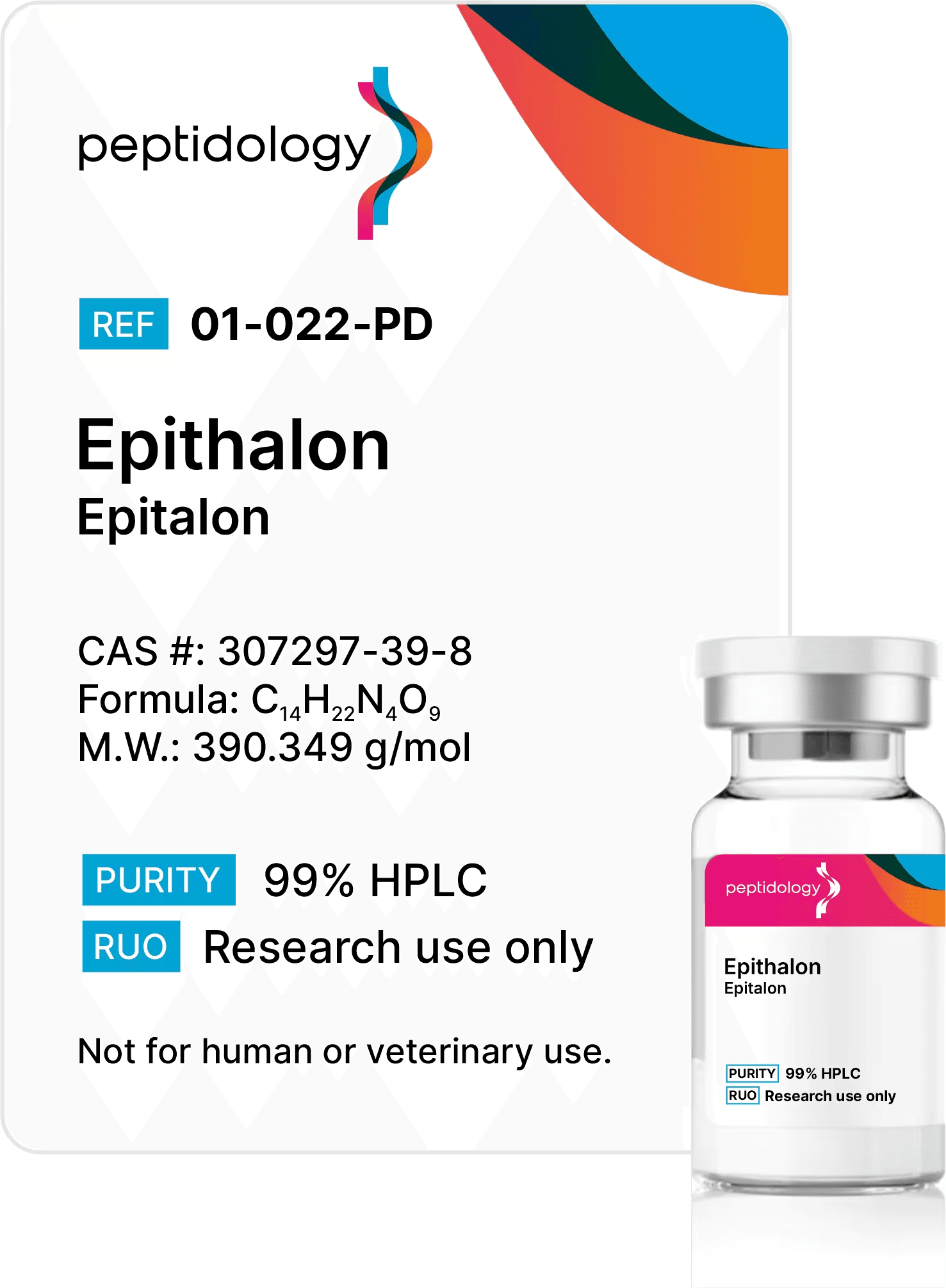
Peptidology Epithalon 60 mg is presented as an investigational tetrapeptide material intended exclusively for controlled professional laboratory research. Epithalon, also written as Epitalon or Epithalone, consists of the four-amino-acid sequence alanine, glutamic acid, aspartic acid, and glycine, commonly abbreviated as AEDG. Scientific investigations have examined this peptide in relation to telomere biology, experimental telomerase activity, cellular-aging models, gene-expression pathways, and peptide-mediated cellular signaling. The stated 60 mg represents the total listed product amount and must not be interpreted as a human dose, administration recommendation, verified concentration, or treatment protocol. This material is not presented as an approved medicine, injectable preparation, dietary supplement, sleep product, longevity product, or veterinary preparation.
The Science of Epithalon Research
Epithalon is a short synthetic tetrapeptide developed from research involving pineal peptide complexes. Its compact AEDG structure has attracted scientific interest because short regulatory peptides may interact with cellular signaling, gene-expression pathways, and nuclear processes. Published investigations include in vitro, animal, and computational studies, but their results remain dependent on the selected experimental model, peptide identity, purity, concentration, exposure conditions, and analytical method.
Telomerase Activity Research: Cell-culture studies have examined whether Epithalon-related exposure may influence the expression or activity of telomerase, the enzyme associated with the maintenance of chromosome-end structures. These laboratory observations remain experimental and do not establish a safe or effective human application.
Telomere Biology: Research has evaluated changes in telomere length in selected normal and transformed cell lines following controlled exposure. Interpretation requires caution because telomere regulation differs substantially between cell types, especially between normal cells and cancer-derived models.
Peptide and Gene Signaling: Epithalon has also been investigated in relation to peptide-DNA interactions, chromatin activity, and gene-expression regulation. These proposed mechanisms require further independent validation and must not be presented as proof of disease prevention, lifespan extension, or clinical benefit.
Review recent laboratory research concerning Epitalon and telomere biology.
Key Research Features of Peptidology Epithalon 60 mg
- AEDG Peptide Identity: Consists of the tetrapeptide sequence Ala-Glu-Asp-Gly.
- Telomere Research Profile: Associated with controlled chromosome-end biology studies.
- Cellular Signaling Relevance: Investigated in peptide-mediated gene and enzyme signaling models.
- 60 mg Research Amount: Provides a stated quantity for laboratory inventory planning.
- Strict Research Classification: Intended exclusively for controlled non-clinical research.
Browse our complete range of peptide research materials.
Specifications
Brand: Peptidology
Product Type: Research Peptide
Category: Tetrapeptide Research Material
Form: Not provided
Size: 60 mg
Strength: 60 mg stated total product amount
Active Ingredients: Epithalon
Ingredient Form: Ala-Glu-Asp-Gly tetrapeptide (AEDG)
Use Target: Controlled telomere, telomerase, and cellular-signaling research
Warnings: Not intended for human or veterinary use
Research Handling Guide
This material should be received, documented, stored, and handled only by trained laboratory personnel working under an approved institutional research protocol. Before beginning an experiment, review the supplier’s certificate of analysis, batch information, peptide-sequence verification, compound-identity documentation, analytical purity method, safety data sheet, storage requirements, and handling instructions. Researchers should use appropriate controls, calibrated equipment, validated analytical procedures, and institutional chemical-hygiene practices. No human dosage, injection, ingestion, reconstitution, compounding, sleep-use, longevity-use, anti-aging application, or self-experimentation instructions are provided or implied by this product listing.
Safety Information
Epithalon remains an investigational research material and must not be presented as an approved medicine, dietary supplement, sleep treatment, or longevity product. It is not intended for human consumption, clinical administration, veterinary use, diagnostic procedures, household use, or cosmetic application. Do not ingest, inject, inhale, or apply the material to the body. FDA has stated that compounded drugs containing Epitalon may present immunogenicity risks for certain administration routes because of potential peptide aggregation and peptide-related impurities. FDA has also identified insufficient safety information to determine whether administered Epitalon may cause harm in humans. Laboratory personnel must follow verified protective, storage, spill-response, transport, exposure-management, and waste-disposal procedures.
Frequently Asked Questions
Are Epithalon and Epitalon the same research peptide?
The names Epithalon, Epitalon, and Epithalone are commonly used for the AEDG tetrapeptide in scientific and commercial contexts. Researchers should still confirm the exact sequence and identity through supplier documentation.
What type of research is Epithalon associated with?
It is associated with laboratory studies involving telomere biology, telomerase activity, cellular aging models, peptide signaling, and gene-expression pathways. Findings remain experimental and model-dependent.
Does 60 mg represent a recommended dose?
No. The 60 mg figure represents the stated total product amount only. It is not a human dose, injection amount, administration schedule, treatment protocol, or confirmed concentration.
Does laboratory telomerase research prove a longevity benefit?
No. Cell and preclinical observations do not prove that the material extends human lifespan or delivers a clinical anti-aging effect. Human safety, effectiveness, and appropriate use have not been established by this listing.


 Click to zoom